
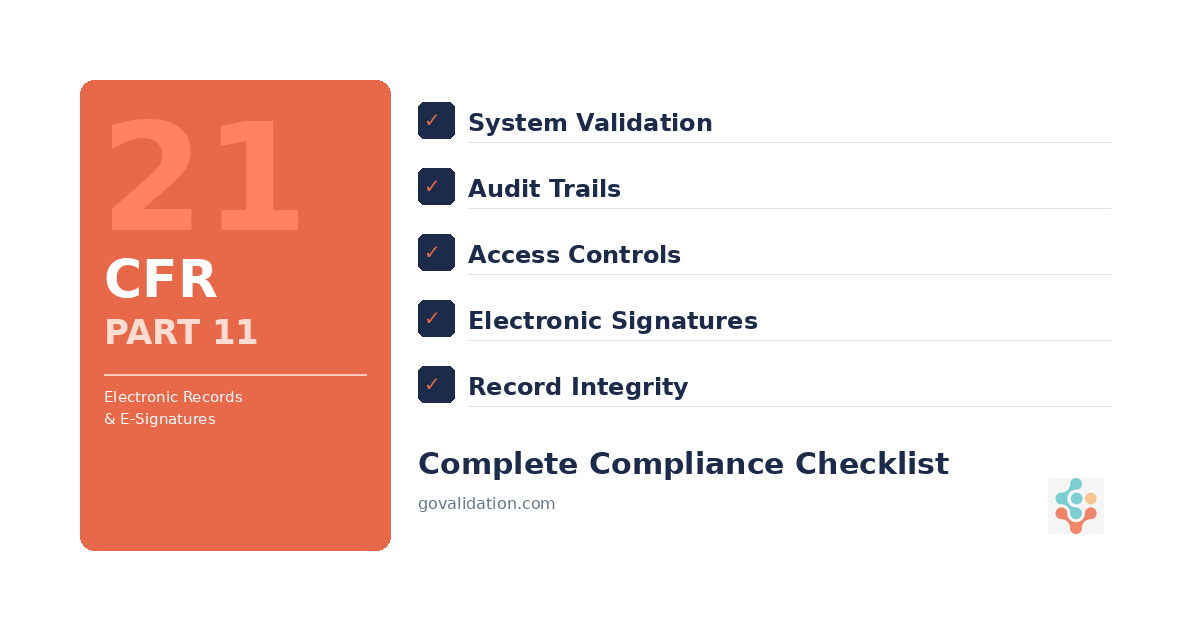
21 CFR Part 11 is the FDA regulation governing electronic records and electronic signatures for all FDA-regulated organisations. It requires validated systems, tamper-evident audit trails, unique user IDs, and e-signatures permanently bound to records. This checklist covers all five requirement areas so you find your gaps before an inspector does.
What 21 CFR Part 11 Actually Requires
Four areas — each with specific technical and procedural requirements your systems and SOPs must satisfy.
System Validation
Every system creating or storing regulated records must be validated before GxP use begins.
Audit Trails
Computer-generated, time-stamped, tamper-evident — reviewed by QA on a documented schedule.
Access Controls
Unique user IDs, role-based permissions, system-enforced password policy, and account lifecycle management.
E-Signature Integrity
Permanently bound to records with signer identity, date/time, and signature meaning at every event.
The Complete 21 CFR Part 11 Checklist
✓ Formal system validation completed IQ, OQ, PQ — or CSA-equivalent risk-based evidence — approved before GxP use. Approach proportionate to GAMP category. |
✓ Validation docs version-controlled and retained All protocols, execution records, and summary reports stored for system lifetime plus regulatory retention period. |
✓ Change control assesses Part 11 impact Every patch, upgrade, or config change goes through formal impact assessment. Cited in over 28% of Part 11-related 483s in 2025. 28% of 483s |
✓ SOPs govern system operation and administration Written procedures cover account management, backup/recovery, incident response, and periodic review of controls. |
✓ Vendor qualification documented Supplier assessment confirms development practices, support model, and security controls before any GxP records are handled. |
✓ Audit trails are computer-generated and automatic All creates, reads, updates, and deletes of GxP records logged automatically — no user trigger required. |
✓ Each entry captures who, what, and when User identity, date/time, action type, and old vs new values recorded in every entry. |
✓ Audit trails are tamper-evident No user — including admins — can modify or delete entries. Any attempted alteration is itself logged and flagged. |
✓ Retained for the required period At least as long as the records they reference — typically batch record lifetime plus regulatory retention period. |
✓ Periodically reviewed with documented evidence QA review schedule exists, reviews executed on time, each review e-signed. Having the trail without reviewing it fails every time. |
✓ Every user has a unique individual ID — no shared accounts Generic or departmental accounts prohibited for any GxP action. Shared accounts are a citable finding regardless of other controls. |
✓ Role-based access limits permissions to job function Lab analyst cannot approve records. Read-only reviewer cannot create entries. Access provisioned by role. |
✓ Password policy is system-enforced, not just SOP-stated Complexity, periodic changes, and lockout after failed attempts enforced by the system — not just documented in a policy. |
✓ Account provisioning and deactivation formally documented Departing employees deactivated promptly with a record showing when and by whom. |
✓ Session timeouts configured and enforced Sessions lock after defined inactivity, preventing unauthorised use of unattended workstations. |
✓ Every e-signature displays all three mandatory elements Signer's full name, date/time, and meaning (Approved/Reviewed/Authored) under §11.50. Missing any one is a citable finding. |
✓ Signatures permanently and inseparably linked to records Impossible to copy, transfer, or remove without detection under §11.70. Bound to record content at the moment of signing. |
✓ Each signing event requires fresh credential entry Under §11.200, every signature requires fresh user ID + password. Session login is not sufficient. "Click to approve" is non-compliant. |
✓ One-time FDA e-signature certification sent §11.100(c) requires a one-time written letter to FDA. Many organisations have never sent it and only discover this during inspection. |
✓ Records remain accurate and readable throughout retention Accessible and unaltered through software upgrades, data migrations, and system decommissioning events. |
✓ Backup and recovery procedures validated and tested Backup documented and verified. Recovery tested at defined intervals confirming complete restoration. |
✓ Printed copies include all e-signature information Paper output includes signer name, date/time, and signature meaning — as informative as the electronic version. |
How GoVal Satisfies Every Part 11 Requirement
| Requirement | How GoVal addresses it |
|---|---|
| System Validation | Validated VLMS infrastructure. IQ/OQ/PQ vendor docs provided at onboarding. Built-in templates for every system you manage. |
| Audit Trails | Automatic, tamper-evident trails on every record. No user — including GoVal staff — can modify entries. |
| Unique User IDs | Shared accounts architecturally blocked, not just policy-prohibited. Role-based permissions strictly enforced. |
| Electronic Signatures | Credential re-entry at every signing event. Name, date/time, and meaning permanently bound to the record. |
| Record Integrity | Tamper-evident cloud storage with automated backups, version history, and configurable regulatory retention periods. |
| Audit Trail Review | Built-in review workflows with configurable schedules, automated reminders, and securely e-signed review records. |
Frequently Asked Questions
What is FDA 21 CFR Part 11? +
Does 21 CFR Part 11 apply to SaaS and cloud systems? +
What are the 21 CFR Part 11 audit trail requirements? +
What must an electronic signature include under 21 CFR Part 11? +
Do we need to certify our e-signatures to the FDA? +
What are the most common 21 CFR Part 11 inspection findings? +
Is EU Annex 11 the same as 21 CFR Part 11? +
How does FDA Computer Software Assurance affect Part 11 compliance? +
What is the difference between a closed and open system under Part 11? +
Find Your Part 11 Gaps Before an Inspector Does
GoVal builds every 21 CFR Part 11 control into the platform by default — tamper-evident audit trails, compliant e-signatures, automated review workflows, and role-based access that structurally prevents shared accounts.