
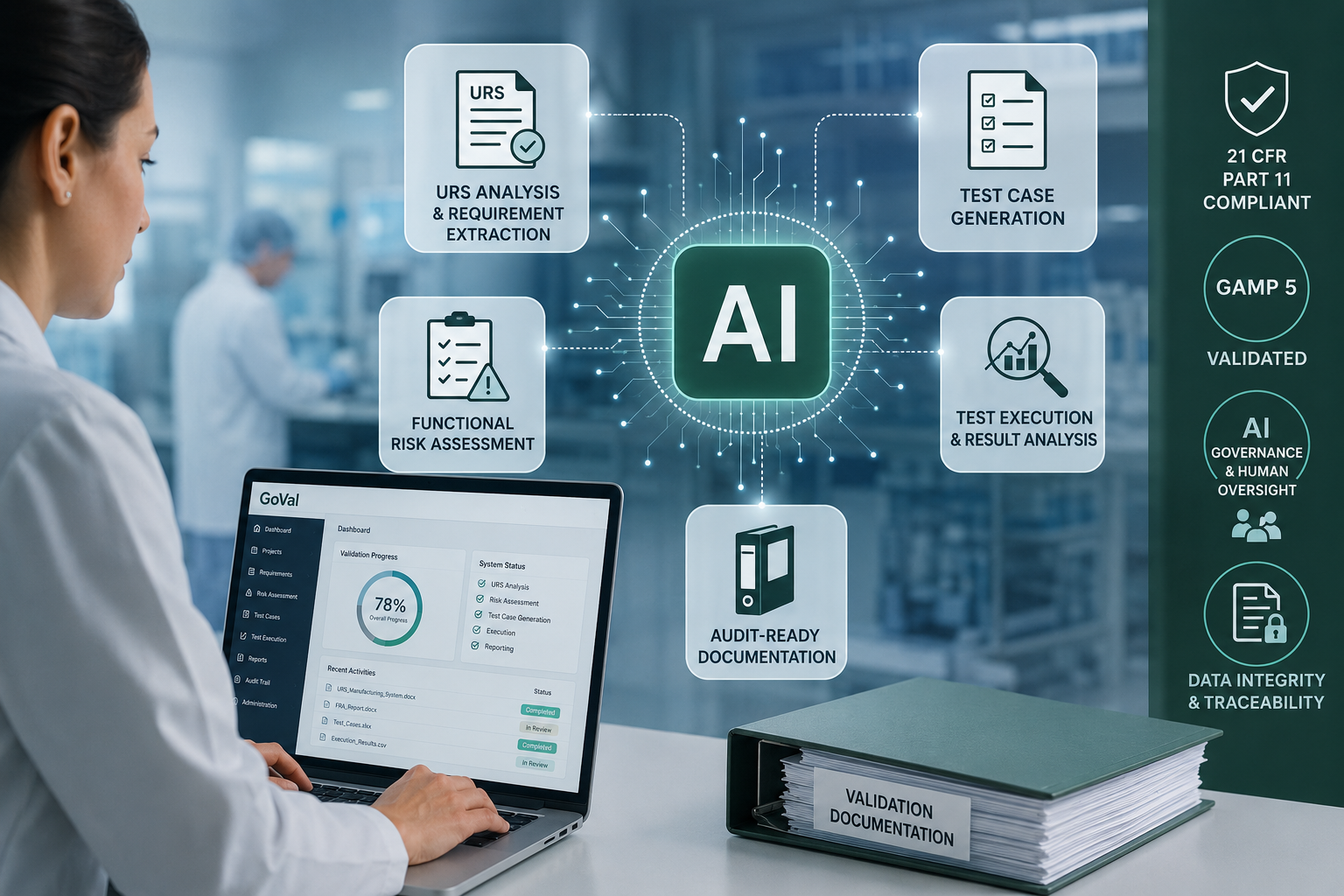
Maintaining compliant documentation, consistent validation practices, and error-free execution in CSV has always been difficult. When teams rely on manual assessment across complex systems, critical requirements get missed, results become inconsistent, and compliance confidence drops. AI-powered validation is changing this — here's how.
Key Challenges in Traditional CSV
Manual CSV has three consistent failure points — each one capable of creating compliance risk on its own, and compounding when they occur together across a multi-system validation portfolio.
- Critical technical terms in URS documents get missed during manual review
- Functional requirements are misinterpreted or partially captured
- Gaps appear in FRA, test cases, and traceability as a result
- Validation completeness and documentation quality suffer
- Multiple teams handling the same activities produce variable outputs
- Documentation formats, testing approaches, and review standards differ
- Data errors and inconsistent results reduce audit confidence
- Inspection readiness depends on who ran the project
- Human error in manual validation is not a matter of if — it's when
- Missing test coverage and incorrect assessments require rework
- Review inefficiencies delay project timelines
- Incomplete documentation increases regulatory risk at audit
When teams interpret the same URS differently across projects, the validation package is only as reliable as the individual reviewer — not the process. That's the core problem AI addresses.
What Organisations Expect from AI in CSV
Teams moving toward AI-enabled validation aren't looking for automation for its own sake. They have three specific expectations — the same three areas where manual processes consistently fall short.
AI is expected to analyse technical data intelligently, improve documentation quality, and reduce manual dependency — not replace the human expertise and regulatory accountability that GxP requires.
The Regulatory Context: What FDA and ISPE Say
How GoVal Addresses These Challenges
| Challenge | What GoVal Does |
|---|---|
| Compliant Content | GoVal's AI analyses URS content and intelligently identifies technical and functional requirements — generating FRA outputs, test cases, requirement interpretations, and actual test result assessments. Critical details are systematically captured rather than left to manual reading. |
| Accuracy & Consistency | Validation documentation is standardised across every project and team. Audit-ready records, real-time data review, and consistent assessment outputs mean inspection readiness doesn't depend on who ran the validation. |
| Decreased Error Rate | AI-assisted validation reduces data errors, inconsistent results, and delayed audits. Manual review effort drops, validation quality improves, and compliance confidence strengthens — without removing human approval from the workflow. |
Frequently Asked Questions
How does AI help in computer system validation (CSV)? +
What are the biggest challenges in traditional CSV processes? +
What is an AI-powered CSV solution? +
Is AI-generated content compliant in pharma validation? +
How does GoVal use AI in computer system validation? +
See how GoVal's AI handles CSV
From URS analysis to FRA generation and audit-ready documentation — all within a pre-validated, Part 11-compliant platform.