
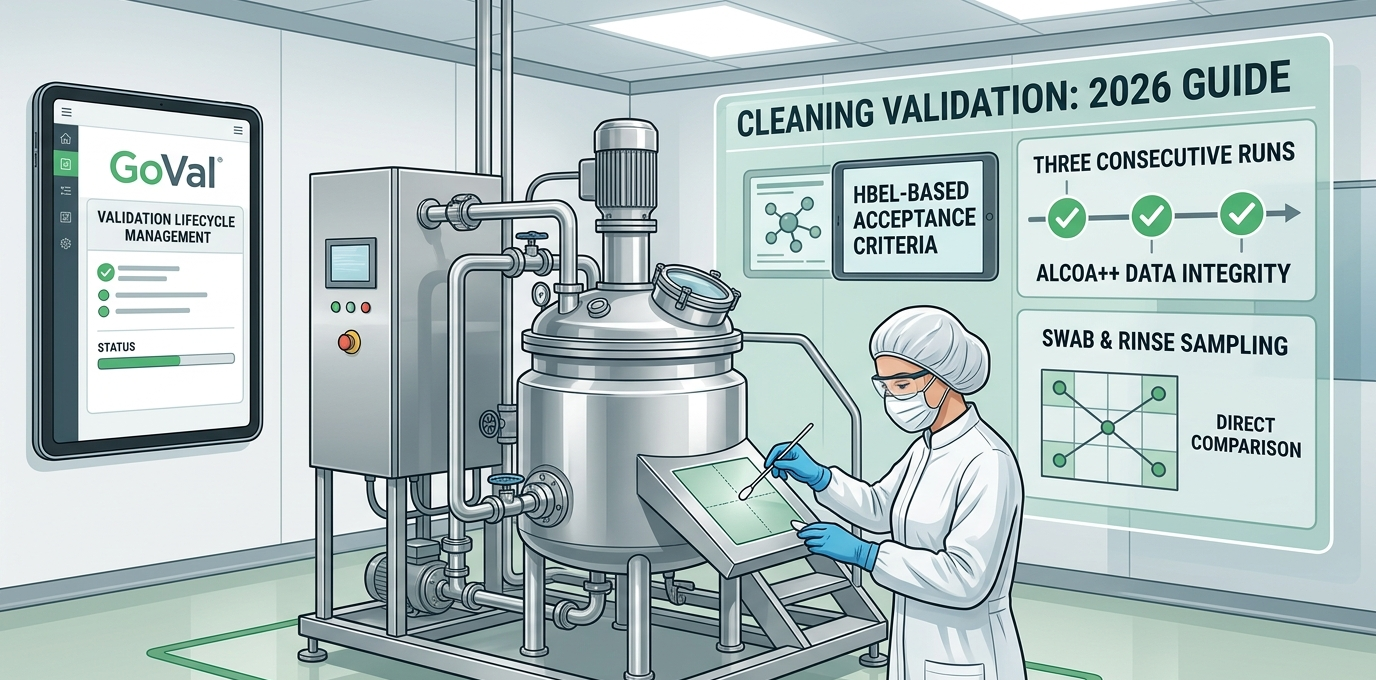
In any multi-product pharmaceutical facility, the residue from yesterday's batch is a direct risk to today's patient. Cleaning validation is documented proof — across three consecutive runs — that your cleaning procedure removes API residues, excipients, and cleaning agents to scientifically justified levels every time. It is one of the most frequently cited areas in FDA 483 observations and EU GMP inspections, and most findings are preventable.
What Cleaning Validation Proves
Cleaning validation demonstrates that a defined cleaning procedure, applied consistently, reduces residues to levels safe for subsequent products and patients — not just once, but every time the procedure is performed. It is required under FDA 21 CFR Part 211.67, EU GMP Annex 15, and WHO GMP guidelines for all multi-use equipment, and failure to validate cleaning is a direct patient safety risk that regulators treat accordingly.
The Six Steps Every Programme Needs
- 1
Define Scope and Worst-Case Selection
Identify all equipment in scope and select the worst-case product — most toxic, least soluble, or hardest to clean — with documented scientific rationale. Inspectors will check this directly.
- 2
Set HBEL-Based Acceptance Criteria
Calculate MACO using toxicology-derived HBELs — not the legacy 10 ppm or 1/1000th dose thresholds EMA replaced in 2014 and FDA inspectors now actively challenge.
- 3
Validate the Analytical Method
The method must be validated for specificity, linearity, and sensitivity at or below the residue limit. An unvalidated method — even if detecting correctly — is a standalone inspection finding.
- 4
Identify Hardest-to-Clean Locations
Document which surfaces, ports, gaskets, and dead legs are most difficult to clean — and swab them. Inspectors check this against your equipment drawings and sampling plan.
- 5
Execute Three Consecutive Successful Runs
All three runs must meet acceptance criteria independently, with full sampling and analytical results documented. Any failure triggers a deviation and restarts the count.
- 6
Maintain with Ongoing Monitoring
Changes to equipment, products, or cleaning agents require revalidation. Routine monitoring and periodic review keep the validated state active — not just filed after initial approval.
Swab vs Rinse Sampling
- Direct surface analysis at specific locations
- Required at hardest-to-clean sites
- Validated swab recovery must be established
- Regulatory default for accessible surfaces
- Final rinse solution collected and analysed
- Used for inaccessible surfaces — tubing, tanks
- Cannot replace swabbing for accessible areas
- Must be scientifically justified in protocol
Note: If your cleaning validation acceptance criteria still cite 10 ppm as the primary basis without HBEL toxicological rationale, you are carrying a documented compliance gap — even if you've never had a finding. EMA mandated HBELs in 2014; FDA inspectors are catching up fast.
How GoVal Manages Cleaning Validation
| Requirement | How GoVal addresses it |
|---|---|
| Protocol authoring | ✓Structured templates with HBEL fields, sampling location maps, and acceptance criteria linked at creation. |
| Three-run tracking | ✓Each run logged as a separate ALCOA++ audit-trailed execution record — who, when, what results. |
| Deviation management | ✓OOS results trigger formal deviation records linked to the parent protocol, with CAPA tracking built in. |
| Change control | ✓Equipment or API changes automatically trigger revalidation impact assessments — no manual chase required. |
| Periodic review | ✓Scheduled review workflows keep cleaning validation status live, not forgotten in a filing cabinet. |
| VSR generation | ✓One-click Validation Summary Report compiles all runs, deviations, results, and approvals — inspection-ready instantly. |
Frequently Asked Questions
What is cleaning validation in pharma? +
What software is used for cleaning validation documentation? +
How many runs are required for cleaning validation? +
What is HBEL and how is it used in cleaning validation acceptance criteria? +
What are the most common cleaning validation 483 observations? +
What is the difference between swab sampling and rinse sampling in cleaning validation? +
Ready to Modernise Your Cleaning Validation Programme?
GoVal manages protocols, three-run execution, deviation tracking, and Validation Summary Reports in one inspection-ready platform — with ALCOA++ data integrity built in by design.