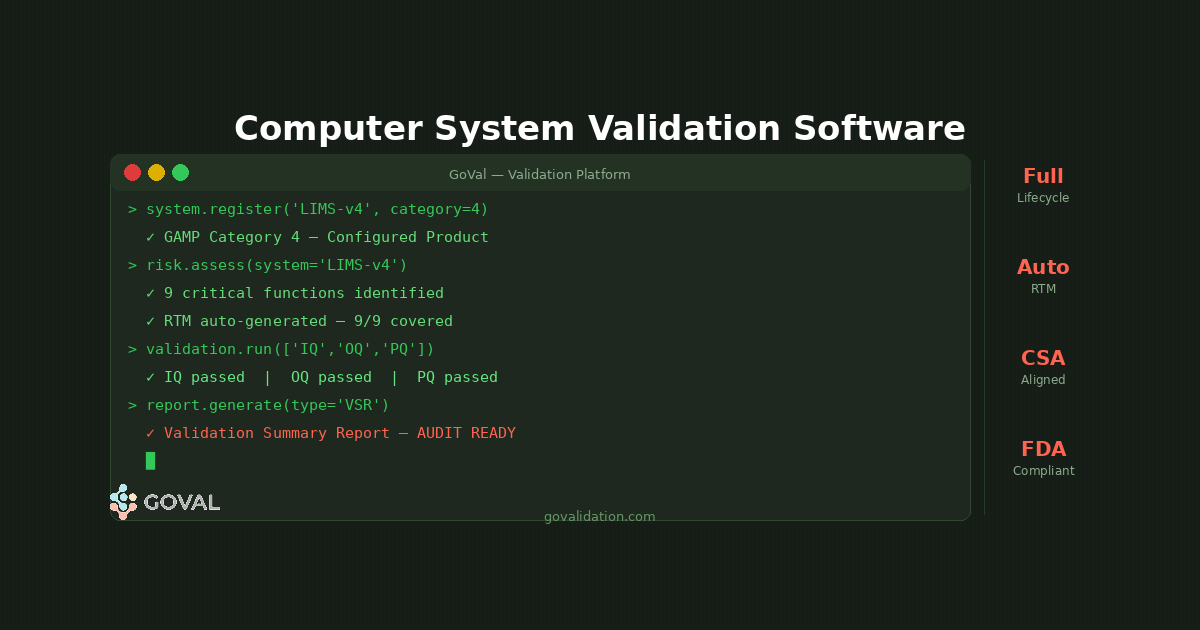
Computer system validation software is not a single category. Some platforms are purpose-built Validation Lifecycle Management Systems covering every phase from system registration to VSR generation. Others are document management tools with a pharma-flavoured marketing layer. Choosing wrong shows up in inspection findings — not just in software bills. This guide is updated for 2026, including FDA's current CSA guidance within its formal medical-device scope and risk-based GAMP 5 practice across broader life sciences.
2026 update: FDA's current CSA guidance was revised in February 2026 and has a formal medical-device production and quality-management-system software scope. It does not change Part 11 requirements. Across life sciences, a modern validation platform should support risk-proportionate assurance evidence while organizations continue to apply the regulations and guidance relevant to their own GxP systems.
What Computer System Validation Software Actually Manages
A GxP system is validated before use, monitored through its life, re-validated after changes, and formally retired — all as interconnected records. Platforms that cover only part of this force manual handoffs, which is exactly where compliance gaps accumulate.
System Inventory
GAMP categorisation, validation status, portfolio visibility
Risk Assessment
GxP impact scoring, critical function identification
Authoring
URS, Functional Spec, Design Spec — AI-assisted
Live RTM
Automatic traceability from requirement to test result
Change Control
Impact assessment integrated with validation record
The Lifecycle a CSV Platform Must Cover
Every stage below must be covered in a single connected system. Gaps between tools are where unvalidated states develop silently.
| Lifecycle Stage | What It Involves | GoVal Coverage |
|---|
| System Inventory | Catalogue GxP systems, assign GAMP categories, track validation status | ✓ |
| Risk Assessment | GxP impact scoring, GAMP categorisation, critical function identification | ✓ |
| Requirements Authoring | URS, Functional Specification, Design Specification | ✓ AI assist |
| Protocol Authoring & Execution | IQ, OQ, PQ digital execution with tamper-evident evidence capture | ✓ |
| Traceability (RTM) | Live RTM linking requirements through risk, tests, and results — real time | ✓ Automatic |
| Deviation & CAPA | Log, investigate, and close test deviations with e-signed resolution | ✓ |
| Change Control | Impact assessment, re-validation triggers, approval workflow | ✓ |
| Periodic Review | Scheduled alerts, evidence collection, e-signed state confirmation | ✓ |
| Reporting (VSR) | Validation Summary Report, RTM, full audit package generation | ✓ One-click |
Where Most CSV Software Fails in Practice
These failure patterns appear repeatedly when validation teams evaluate or switch platforms — and none of them are obvious in a vendor demo.
Digitises the old process without improving it
Paper protocols move to screens. RTM still manual. Approval cycles unchanged. Same cycle times with a higher software bill.
Traceability is a report, not a live record
RTM generated as an export after validation — no real-time coverage view during testing. Coverage gaps discovered too late to fix cheaply.
Change control lives in a separate system
Validation records and change requests managed apart. The link — impact assessment — depends on someone remembering to check. Unvalidated states develop silently.
CSA claimed but not delivered
Same document set applied to every system regardless of risk. Real CSA support means the platform adapts requirements to each system's GAMP category automatically.
What GoVal Does Differently
GoVal was built to solve the specific failure modes above — not retrofitted after the fact.
Live automatic RTM
RTM exists from the first requirement and updates in real time. No separate document to maintain — ever.
Embedded risk assessment
Risk is part of system registration, not a separate document. GAMP category drives the document set automatically.
Integrated change control
Change logged → platform identifies affected qualification records → routes re-assessment workflow automatically.
AI-assisted authoring
Requirements and test cases generated in GxP-accurate regulatory language at a fraction of manual time.
Related Topics
Frequently Asked Questions
What is the best computer system validation software for pharma in 2026? +
The best CSV software for pharma in 2026 is a purpose-built Validation Lifecycle Management System (VLMS) — not a generic document management tool with a pharma label. Look for platforms that provide automatic RTM generation, risk-adaptive GAMP 5 workflows, integrated change control, built-in 21 CFR Part 11 e-signatures, and one-click audit-ready reporting. GoVal is purpose-built for this and covers the full lifecycle from system registration to VSR generation.
What does computer system validation software manage? +
Computer system validation software manages the full GxP validation lifecycle — system inventory and GAMP categorisation, risk assessment, URS and specification authoring, IQ/OQ/PQ protocol execution, live RTM generation, deviation management, change control, periodic review, and Validation Summary Report generation. A complete platform covers all phases in one connected system rather than requiring separate tools with manual handoffs.
How much does computer system validation software cost? +
CSV software costs vary widely — from subscription-based purpose-built platforms like GoVal designed for mid-market pharma, to enterprise VLMS systems requiring six-figure annual licences and months of implementation. The real cost comparison is total cost of ownership: platform licence + implementation services + internal resource time + audit risk from gaps. Purpose-built platforms with fast deployment typically have a significantly lower total cost of ownership than enterprise alternatives.
What is the difference between CSV software and a VLMS? +
CSV software typically covers the initial validation project — protocol authoring, test execution, and reporting. A Validation Lifecycle Management System (VLMS) covers the entire system lifecycle from registration through retirement, including ongoing change control, periodic review, and continuous compliance monitoring. GoVal is a VLMS — it manages the full lifecycle, not just the initial validation project.
How does CSV software support 21 CFR Part 11 compliance? +
A compliant CSV platform provides: electronic signatures capturing signer identity, date and time, and meaning with credential re-entry per signing event; computer-generated tamper-evident audit trails on all record changes; unique user accounts with role-based access controls; and the platform itself must be validated. These are core architecture requirements, not optional configurations.
Do I still need CSV software if I'm adopting FDA CSA? +
Yes. FDA's current CSA guidance, revised in February 2026 for medical-device production and quality management system software, illustrates how assurance evidence can be proportionate to intended use and risk; it does not eliminate the need to manage that evidence. A platform designed for CSA manages risk-based evidence more efficiently than one built for traditional CSV. GoVal supports both approaches and adjusts automatically based on each system's GAMP category.
How does GoVal generate a Requirements Traceability Matrix automatically? +
In GoVal, every test case is linked to its source requirement at the point of creation — not as a post-validation exercise. As testing progresses, GoVal maintains a live RTM showing requirement coverage in real time. When testing is complete, the RTM is available as a one-click report linking every requirement through its risk assessment, test cases, and results. There is no separate RTM document to maintain.
How long does it take to implement computer system validation software? +
Enterprise VLMS platforms can take 6–12 months to deploy with significant internal and consulting resources. Purpose-built platforms like GoVal have validation teams executing their first projects within weeks of contract. The biggest time differences are in configuration complexity, vendor qualification effort, and how much training your team needs.
See GoVal Manage the Full CSV Lifecycle
From system inventory to audit-ready VSR — one connected platform, no manual handoffs, no spreadsheets. Book a demo tailored to your specific systems and validation programme.