
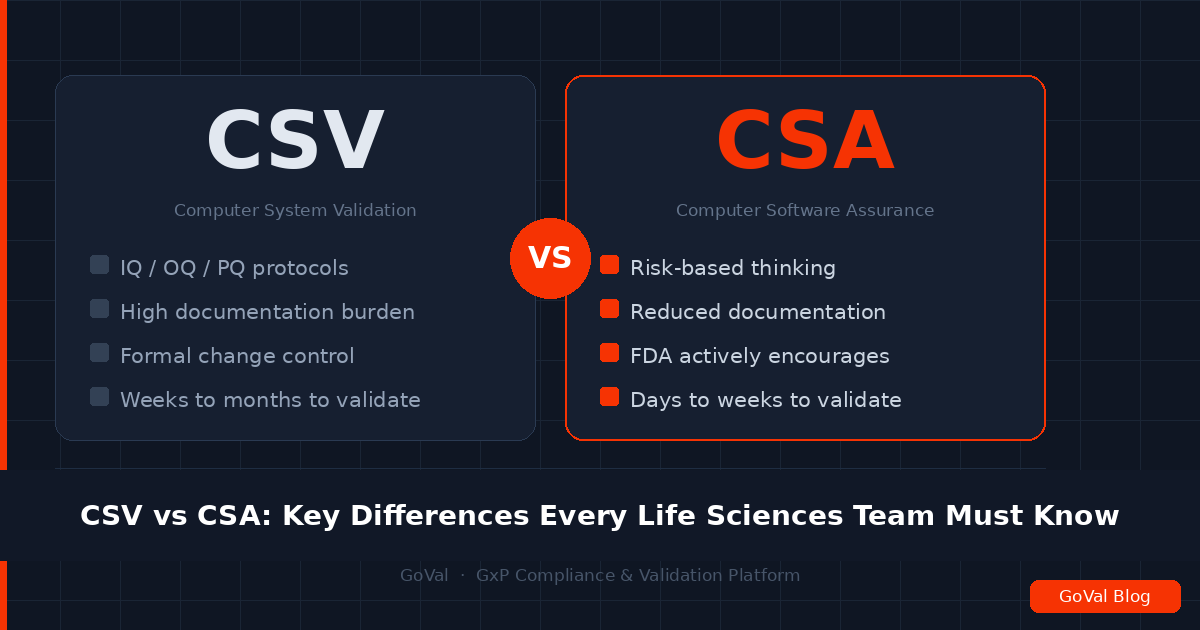
CSV vs CSA: The Core Differences
A side-by-side view of how the two frameworks differ across the key dimensions that matter most to your team.
| Dimension | CSV | CSA |
|---|---|---|
| Philosophy | Document everything | Document what adds value |
| Testing | Protocol-based IQ / OQ / PQ | Risk-based critical thinking |
| Documentation | High volume | Reduced, purposeful |
| Change Control | Formal, often triggers re-validation | Proportionate to risk |
| Time to Validate | Weeks to months | Days to weeks |
| FDA Stance | Established standard | Actively encouraged |
| Best For | High-risk, direct-impact systems | SaaS, lower-risk supporting systems |
How to Choose: A Simple Decision Framework
Neither framework is universally better. The right one depends on three things: how directly the system affects patient safety, how complex the system is, and what your regulatory environment expects.
Stick with CSV when...
Your system directly controls a manufacturing process — think SCADA, DCS, automated filling lines, or anything that feeds a batch release decision. Also consider CSV if your organisation is in a heavily inspected environment where auditors have conservative expectations, or where CSV is already baked into your SOPs and quality system.
Move to CSA when...
You are implementing a modern cloud or SaaS platform that supports GxP processes without directly controlling them — a LIMS, a QMS, a training management system, or a document management platform. These are exactly the systems the FDA had in mind when it wrote the CSA guidance. The vendor already tests the software extensively; your job is to confirm it works for your intended use.
Run both in parallel when...
You have a mixed portfolio, which most organisations do. A hybrid validation approach applies CSV rigour to high-risk systems and CSA principles to everything else. The key is having a clear, documented rationale for each choice — not applying one framework across the board for convenience.
How GoVal Supports Both Frameworks
GoVal's validation lifecycle management platform (VLMS) is built around the idea that different systems need different approaches. You set the risk category and validation pathway at the system level, and GoVal adjusts the required documentation, templates, and approval workflows accordingly.
For CSV Work
Pre-built IQ, OQ, and PQ protocol templates, automated test execution with full evidence capture, 21 CFR Part 11-compliant electronic signatures, and a complete audit trail from requirement through to executed test.
For CSA Work
Configurable risk assessment workflows, vendor assessment tools, critical thinking documentation templates, and reduced protocol sets that are calibrated to the actual risk of the system rather than a fixed template.
For Both
A real-time traceability matrix, one-click audit package generation, and no paper. GoVal adjusts templates, documentation requirements, and workflows per system — so your team has the right process without managing two separate tools.
Frequently Asked Questions
Common questions about CSV, CSA, and how GoVal supports both frameworks in regulated life sciences environments.
Ready to Streamline Your Validation?
Whether you are running CSV, CSA, or both, GoVal gives your team the right process for every system. See how Alembic Pharmaceuticals and Sai Life Sciences achieved 100% paperless validation, or contact our team to book a live demo.