
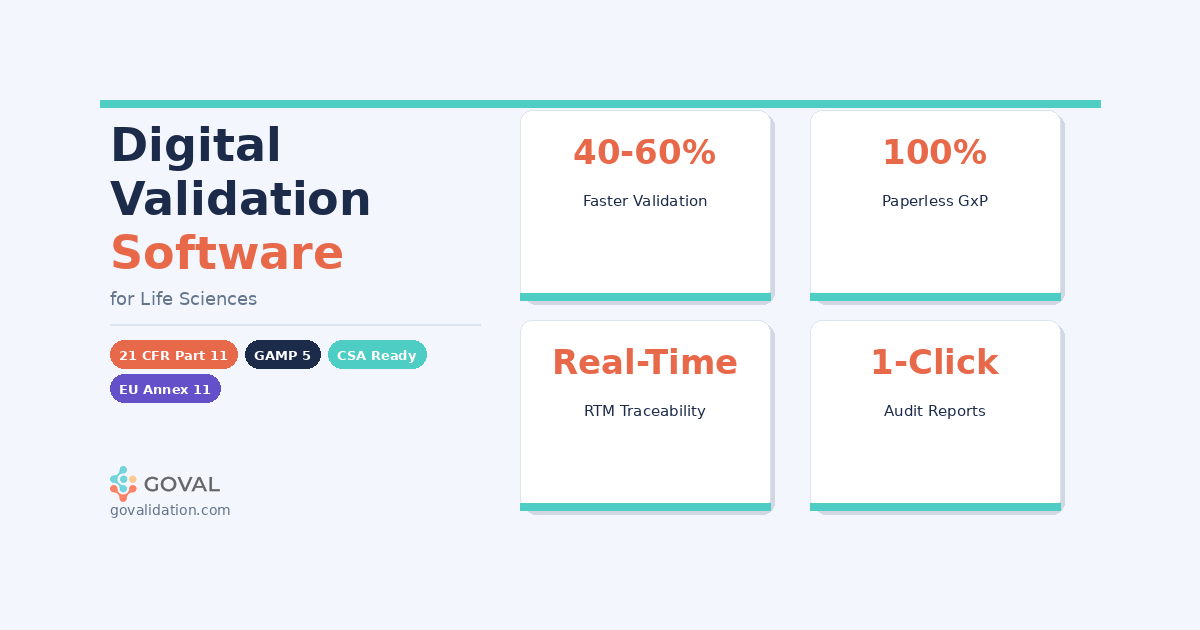
Good digital validation software should do more than replace paper with electronic forms. It should connect intended use, risk, requirements, assurance evidence, traceability, deviations, approvals, changes, and review while preserving trustworthy electronic records. For pharma, biotech, and medtech buyers, the most important evaluation criteria are lifecycle coverage, data integrity and e-signature controls, risk-based workflow flexibility, supplier evidence, integrations, reporting, and the effort required to implement and maintain the platform.
Use this guide with the validation software comparison, the VLMS guide, and the GoVal CSV workflow.
Define Your Primary Problem Before Evaluating Platforms
A tool that solves problem one brilliantly may do nothing for problem three. Get clear on your primary driver before entering a vendor demo.
| Primary Problem | What You Actually Need |
|---|---|
| Too much paper, signatures stuck in email | A platform with electronic-record and signature controls that can be configured and validated for your intended Part 11 use case |
| Need to adopt CSA, reduce documentation overhead | Risk-based workflow that considers intended use, GxP impact, functional risk, complexity, supplier evidence, and configuration/customization |
| Legacy systems under-documented, audit risk building | VLMS with system inventory, gap tracking, and portfolio visibility |
| Growing fast, multiple sites, inconsistent approaches | Enterprise VLMS with multi-site support and template governance |
| Slow cycle times and too much manual coordination | Workflow automation, connected traceability, reusable controlled content, digital execution, and optional AI assistance with appropriate human review |
Five Things That Separate Good Digital Validation Software From the Rest
- Traceability that is automatic, not manual — RTM must update in real time as test cases link to requirements. Post-validation RTM exports = the same problem, digitised at a higher cost.
- Risk-based workflows, not one-size-fits-all templates — Workflow and assurance depth should reflect intended use, GxP impact, functional risk, complexity, novelty, supplier evidence, and the extent of configuration or custom code. Software category can inform planning, but it should not act as an automatic risk score.
- Electronic-signature controls appropriate to the intended use — For Part 11 use cases, verify identity controls, signature meaning, date/time, linkage of the signature to the record, auditability, and the organization’s credential/signing controls. Ask the vendor to demonstrate the complete signing event rather than relying on a checklist.
- Change control connected to the validation record — Change management should stay connected to the validation record so affected systems, requirements, risks, and evidence can be assessed without relying on disconnected manual handoffs.
- Audit readiness built into normal operation — Evaluate whether current, approved evidence can be retrieved without reconstructing a validation package manually. Reporting should reflect the controlled source records and their current status.
Questions to Ask Every Vendor Before You Buy
Use these questions to test how the platform behaves in a real regulated workflow rather than relying on labels or feature checkmarks.
| Area | Ask This & Why It Matters |
|---|---|
| Platform validation | "What supplier documentation is available for our assessment?" Ask what versions the evidence covers, how releases are communicated, and which customer-specific assurance activities remain your responsibility. |
| CSA support | "Show how risk changes the assurance workflow for this use case." Verify that intended use, GxP impact, functional risk, complexity, supplier evidence, and configuration or customization influence the assurance approach rather than software category alone. |
| 21 CFR Part 11 | "Walk me through a signing event — what is captured and where is it stored?" Shows how electronic-signature controls actually behave for your intended use rather than relying on a compliance label. |
| Implementation | "What is your median time-to-first-validated-system for organisations our size?" Separates realistic deployment timelines from best-case sales scenarios. Ask for a comparable customer cohort, assumptions, dependencies, and the milestone used to define implementation completion. |
| Change management | "Show how a released change is assessed against existing validation evidence." Verify which records are linked, what impact analysis is prompted, what updates automatically, and where human review and approval are required. |
Shortlisting validation software? Use one of your real workflows in a GoVal evaluation and test traceability, e-signatures, risk decisions, deviations, change impact, and reporting end to end.
Implementation Timeline: What to Expect
Broader enterprise platforms
Implementation effort depends on platform breadth, configuration, integration, migration, governance, and the customer’s operating model. Ask for a scoped implementation plan and customer references with comparable complexity.
GoVal (purpose-built)
Ask GoVal to scope the path to your first approved workflow, including configuration, supplier documentation, integrations, training, data migration if any, and your internal approval requirements.
Failure Modes to Test Before You Buy
A polished demo can hide operational gaps. Test these scenarios with one of your real validation workflows before selecting a platform.
How GoVal Approaches the Workflow
GoVal is designed around connected validation lifecycle records rather than a collection of independent documents. In an evaluation, verify these capabilities using your own requirements, risk model, approval flow, and change scenario.
Related Topics
Frequently Asked Questions
What is the best digital validation software for pharma and life sciences in 2026? +
How much does digital validation software cost for a mid-size pharma company? +
What is digital validation software in life sciences? +
Does digital validation software itself need to be validated or assured? +
How long does it take to implement digital validation software? +
What is the difference between a VLMS and general validation software? +
Can small and mid-size pharma companies benefit from digital validation software? +
What questions should I ask a digital validation software vendor before buying? +
Evaluate GoVal With Your Own Validation Workflow
Bring one real system, qualification, or change scenario. We will walk through how GoVal connects risk, requirements, evidence, deviations, approvals, traceability, and controlled change from start to approved record.
Talk to a Validation Specialist →