
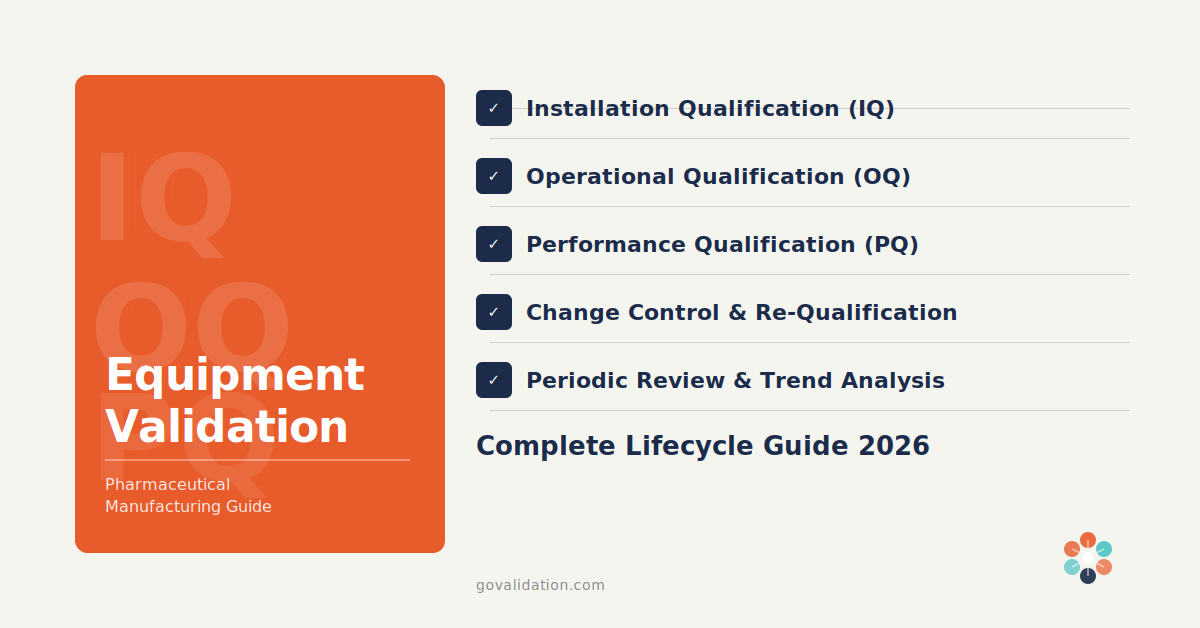
What is equipment validation in pharma?
Equipment validation in pharma is documented evidence that equipment is fit for its intended GMP use and remains in a controlled state throughout its lifecycle. Qualification commonly uses Installation Qualification (IQ), Operational Qualification (OQ), and Performance Qualification (PQ), with the exact evidence scaled to equipment criticality, intended use, process risk, and applicable site procedures. The lifecycle does not end at PQ: changes, maintenance, calibration events, deviations, and periodic review can all affect the qualified state.
If you are building or reviewing an equipment programme, see the GoVal equipment validation workflow and our IQ/OQ/PQ guide for the qualification sequence and evidence model.
Lifecycle point: A well-executed IQ/OQ/PQ package can still lose value if later changes, calibration failures, maintenance, or review findings are not assessed for impact on the qualified state. Treat qualification evidence and ongoing control as one connected record.
Equipment vs Software Validation — Why the Same Framework Produces Different Evidence
Equipment qualification and software assurance can use different lifecycle structures. IQ/OQ/PQ is common for physical equipment, while computerized-system assurance should use evidence appropriate to intended use, GxP impact, risk, and system characteristics.
| Dimension | Equipment Validation | Software Validation |
|---|---|---|
| System Nature | Physical systems wear, drift, and degrade over time. | Software does not wear between versions. |
| Risk Focus | Qualification must account for ageing, component replacement, and performance drift across manufacturing campaigns. | Compliance risk comes from configuration drift, vendor updates, and changes in intended use. |
| Re-qualification / Re-assessment Triggers | Changes, relocation, maintenance, calibration events, performance drift, or review findings may trigger assessment. | Changes in configuration, intended use, integrations, vendor releases, security, or regulated processes may trigger re-assessment. |
| Lifecycle Monitoring | Review frequency and monitoring should follow applicable GMP requirements, risk, maintenance strategy, and site procedures. | Ongoing assurance typically considers changes, access, audit trails, incidents, supplier updates, and continued fitness for intended use. |
The Three Qualification Phases: What Each Actually Proves
Understanding the distinct purpose of each phase prevents the most common documentation gaps.
- IQInstallation Qualification: Is it installed exactly per specification — right services, right instruments, all calibrated at time of IQ?
Key checks include serial numbers, utility connections, safety systems, cleaning procedures, and verified calibration certificates.
Common failure pattern: Calibration status assumed, not verified at IQ execution - OQOperational Qualification: Does it operate correctly across the full qualified range — targets, boundaries, and challenge conditions?
Key checks include range testing, boundary conditions, challenge tests, and pre-defined acceptance criteria.
Common failure pattern: Criteria looser than process requirements - PQPerformance Qualification: Does it perform consistently under real production conditions — real product, real operators, real schedules?
Key checks include consecutive production runs, representative process data, and a risk-justified run count.
Common failure pattern: Run count not risk-justified — defaulting to three
Equipment Qualification Summary Table
Primary question, typical evidence, and a common failure pattern for each phase.
| Phase | Primary Question | Key Evidence | Common Failure Pattern |
|---|---|---|---|
| IQ | Is it installed correctly with all services and instruments verified? | Installation records, calibration certs, utility checks, serial numbers | Calibration status not verified at IQ execution |
| OQ | Does it operate correctly across the full qualified range? | Range tests, boundary conditions, challenge tests, pre-defined criteria | Acceptance criteria looser than process requirements |
| PQ | Does it perform consistently under real production conditions? | Consecutive production runs, process parameter data, run count justification | Run count not documented and risk-justified — defaulting to three |
Three Areas Most Teams Under-Invest In
The initial qualification can be strong while lifecycle controls become fragmented later. These three areas deserve explicit ownership and evidence.
- Change control and re-qualification
Every equipment change — replaced component, modified control parameter, relocated instrument — needs a change control assessment explicitly asking whether re-qualification is required. Many processes skip this question, leaving equipment operating outside its validated state without detection. - Calibration programme integration
Equipment qualification and the calibration programme must be connected. When a critical instrument goes out of calibration, the impact on qualification status must be assessed — not just logged in the calibration system and corrected in isolation. - Periodic review with trend analysis
A periodic review that only checks whether changes have occurred is insufficient. Effective review analyses trend data — process parameter drift, alarm frequency, maintenance history, OOS incidents — and produces a documented conclusion on whether the qualified state is maintained.
Need a connected equipment record? See how GoVal manages equipment qualification from requirements and IQ/OQ/PQ through deviations, change impact, review, and approval.
How GoVal Manages Equipment Validation Lifecycle
Equipment validation generates significant ongoing documentation — all of it needs to be linked, traceable, and inspection-ready at any moment.
| What You Need | How GoVal Delivers It |
|---|---|
| IQ through PQ in one platform | Full equipment qualification lifecycle with automatic traceability linking URS requirements to executed test results |
| Periodic review alerts | GoVal tracks review due dates for every qualified asset and sends automated alerts before they are overdue |
| Change impact assessment | Every change triggers a structured re-qualification impact assessment with a documented decision before the change is implemented |
| Equipment portfolio dashboard | Qualification status, pending reviews, open deviations, and calibration linkage for every asset in one real-time view |
| Calibration integration | Calibration status linked to qualification records — so a calibration failure automatically flags the affected qualified state for impact review |
| Audit-ready at all times | Complete qualification records available immediately — not compiled over days in response to an inspection notice |
Related Topics
Frequently Asked Questions
What equipment in a pharma facility requires validation? +
How long does pharmaceutical equipment validation take? +
What is the difference between equipment qualification and process validation? +
When is equipment re-qualification required in pharma? +
What does EU GMP Annex 15 require for equipment qualification? +
How does FDA view equipment qualification versus EU GMP Annex 15? +
What are the most common equipment validation inspection findings? +
Can GoVal manage equipment qualification alongside computer system validation? +
Manage Your Full Equipment Validation Programme in One Place
GoVal gives your team IQ through PQ templates, automated periodic review scheduling, change impact assessments, and a real-time portfolio dashboard — all in one platform built for GMP-regulated environments.