
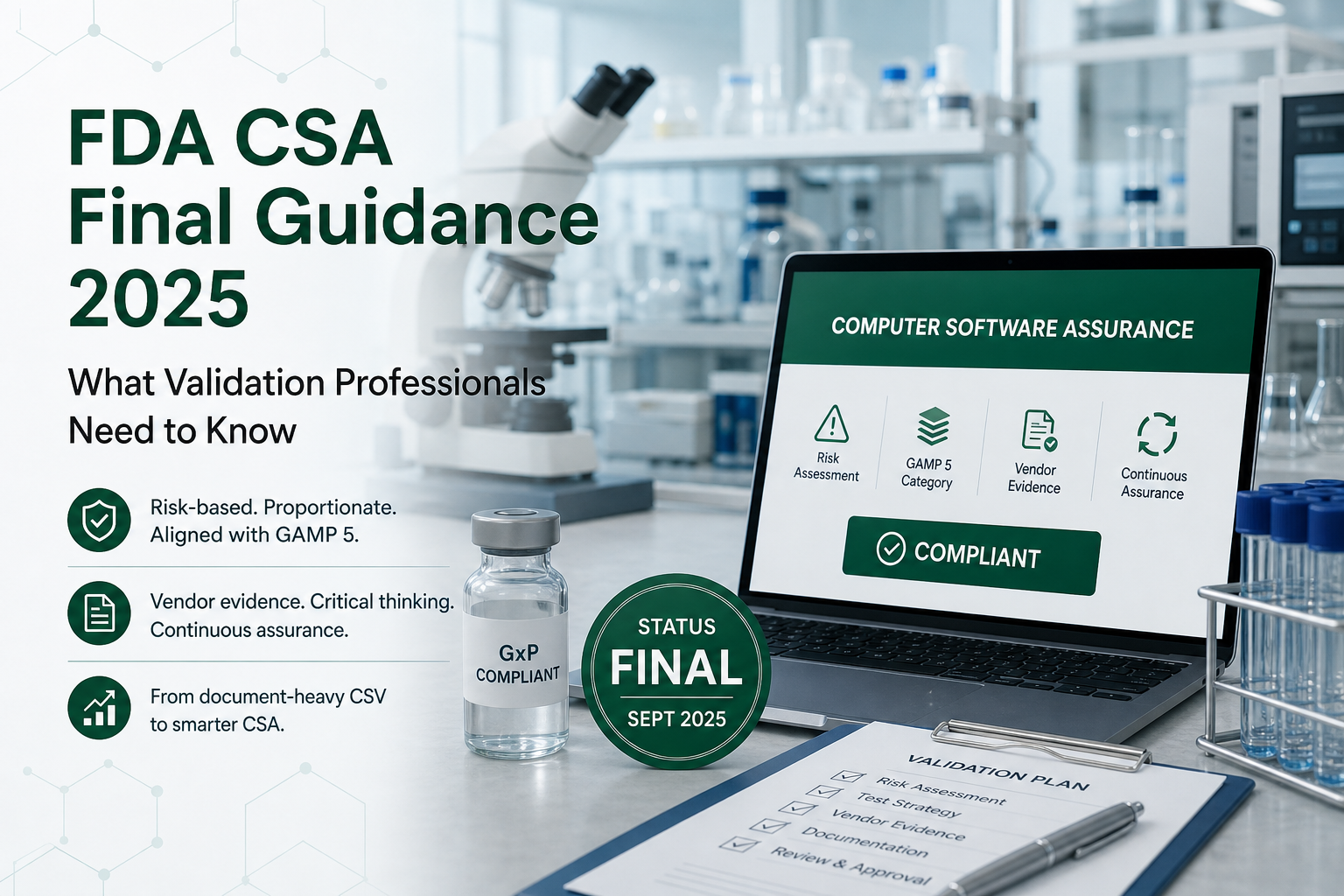
FDA revised its Computer Software Assurance for Production and Quality Management System Software guidance in February 2026 to align with the Quality Management System Regulation (QMSR). The revision supersedes the September 2025 final guidance and retains the core risk-based assurance approach for medical-device production and quality management system software.
From 2022 Draft to the February 2026 Revision
FDA released the CSA draft in September 2022, issued Level 1 final guidance on September 24, 2025, and revised that final guidance in February 2026. The 2026 revision aligns the document with the amended 21 CFR Part 820 Quality Management System Regulation (QMSR) and supersedes the September 2025 version.
Guidance History: What Changed
| Stage | Date | What it means |
|---|---|---|
| Draft guidance | September 2022 | Introduced FDA's proposed risk-based Computer Software Assurance approach. |
| Level 1 final guidance | September 24, 2025 | Finalized the CSA recommendations for production and quality system software. |
| Current revision | February 2026 | Revised the final guidance to align with the amended 21 CFR Part 820 Quality Management System Regulation (QMSR) and superseded the September 2025 version. |
| Core approach | Current | Risk-based assurance remains the central model: choose assurance activities based on intended use and risk, using supplier evidence where appropriate. |
Using GAMP 5 Categories Alongside CSA Principles
- Cat 1Infrastructure Software — OS, networks, databases. Vendor evidence and configuration records sufficient. No scripted testing required.
- Cat 3Commercial Off-the-Shelf (COTS) — Used as-supplied with no configuration. Vendor documentation and basic installation verification typically sufficient.
- Cat 4Configured Commercial Software — QMS, LIMS, ERP, MES. Vendor evidence covers the base platform; your testing focuses on critical configured functions only.
- Cat 5Custom Software — Bespoke or custom-developed code. CSA does not reduce requirements here. Full SDLC lifecycle validation is still required.
Five Things Your Programme Should Address Now
- ✓Classify your inventory by GAMP 5 category. Without this, you can't apply proportionate effort — or defend your approach in an inspection.
- ✓Document your risk rationale. The "why" behind your validation scope is now a required part of the assurance package — not just an internal note.
- ✓Collect and reference vendor evidence. For Category 3 and 4 systems, formally reference vendor test packages rather than re-executing equivalent tests.
- ✓Update your Validation Master Plan. If your VMP still describes uniform CSV for all systems, update it to reflect your CSA-aligned risk rationale and scope.
- ✓Move toward continuous assurance. The final guidance references maintaining systems in an ongoing state of assurance — periodic review should be proportionate and built into the lifecycle.
How GoVal Supports CSA Implementation
GoVal classifies systems using GAMP 5 categories, captures intended use and risk, scales test planning proportionately, supports supplier evidence, and maintains traceability across requirements, risks, testing, deviations, and approvals. For medical-device workflows, this can support FDA CSA-aligned assurance. For pharma and biotech, the same platform can support risk-based validation under the GxP requirements applicable to the system.
Frequently Asked Questions
What changed in the FDA CSA guidance in February 2026? +
Does FDA CSA guidance apply to all pharma software? +
Does FDA CSA define GAMP 5 software categories? +
Does CSA replace CSV? +
How does GoVal support CSA-aligned validation? +
See how GoVal supports current FDA CSA principles
Risk classification, proportionate documentation, vendor evidence management, and continuous assurance — built into every validation workflow from day one.
Book a Free Demo →