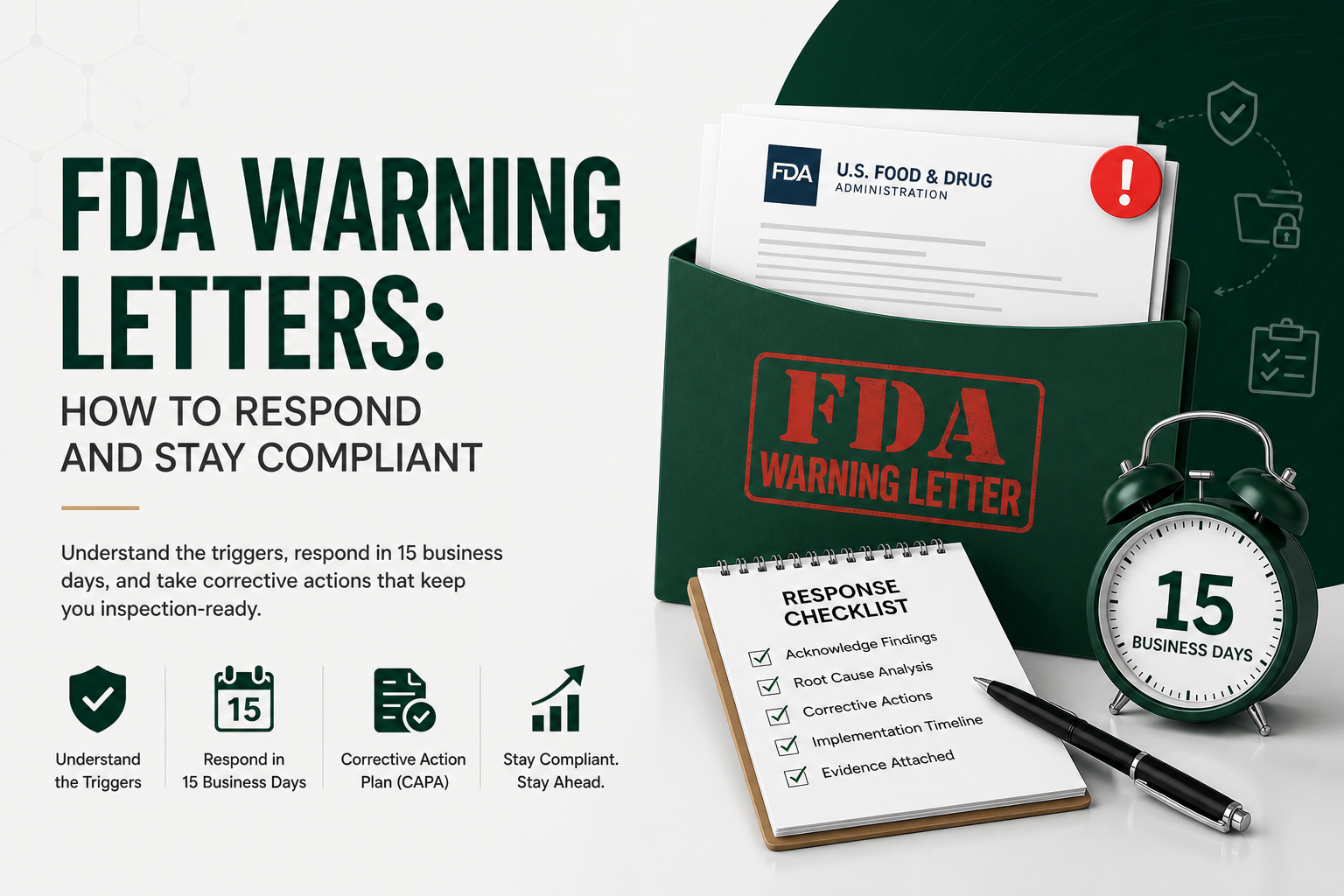
An FDA Warning Letter is serious — but how you respond in the first 15 business days determines whether it resolves or escalates to import alerts and injunctions. Here's what triggers them in validation and what a strong response looks like.
Form 483 vs Warning Letter
Form 483
Inspection Observation
- Issued by the investigator at close of inspection
- Not public — shared only with the company
- Strong response can prevent escalation
Warning Letter
Regulatory Action
- Issued by FDA headquarters — public on FDA.gov
- Confirms violations are significant and unresolved
- Weak response can trigger import alerts or injunctions
Most Common Validation Findings
| Finding | What FDA Cites | Frequency |
|---|
| Audit Trail Deficiencies | Trails disabled, not reviewed, or alterable without capture | Very Common |
| Unvalidated Computer Systems | GxP software used without IQ/OQ/PQ or Part 11 assessment | Very Common |
| Uncontrolled Spreadsheets | Excel used for GxP records without access controls or audit trail | Very Common |
| Shared User Accounts | Multiple users sharing credentials — individual attribution impossible | Common |
| Inadequate E-Signatures | Signatures missing date, time, or meaning — not Part 11 §11.50 compliant | Common |
Unprotected Excel cells, overwritable formulas, and no system-level change record — FDA treats this as a data integrity failure, not an administrative gap.
The 15-Day Response Timeline
The clock starts from receipt. Every action must include a specific date and supporting evidence — vague commitments to "investigate" are consistently rejected and can accelerate enforcement.
Assemble your response team
QA lead, regulatory counsel, validation engineering, and senior management aligned. Assign one response owner.
Root cause each observation
Identify the systemic origin — not the surface symptom. Fix the system that allowed the error, not just the error.
Draft CAPA with specific dates
What was done, what will be done, and a completion date per action. Concrete evidence — not commitments.
File with evidence attached
Updated SOPs, validation records, corrected system screenshots. A well-written response without evidence carries no weight.
How GoVal Helps
GoVal eliminates the most common Warning Letter triggers by design — enforced audit trails, Part 11-compliant e-signatures, role-based access, and pre-validated IQ/OQ/PQ lifecycle management. For teams already under a Warning Letter, GoVal deploys in 3–6 weeks with the corrective action evidence FDA expects.
Frequently Asked Questions
What is an FDA Warning Letter? +
An FDA Warning Letter is an official communication notifying a company of significant regulatory violations that warrant enforcement action if not corrected. Unlike a Form 483 observation — issued at inspection close and not a regulatory action — a Warning Letter is public, posted on FDA.gov, and signals the agency views violations as serious. Companies have 15 business days to respond.
What is the difference between an FDA 483 and a Warning Letter? +
A Form 483 is issued by an FDA investigator at inspection close listing observed conditions that may constitute violations — it is informal and not a regulatory action. A Warning Letter is issued by FDA headquarters after reviewing the 483 response, when violations are confirmed as significant and unresolved. Warning Letters are public, legally significant, and carry potential enforcement consequences including import alerts and injunctions.
How long do you have to respond to an FDA Warning Letter? +
FDA expects a written response within 15 business days of receiving the Warning Letter. The response must acknowledge violations, describe specific corrective actions already taken, and provide a timeline for remaining corrections. Vague commitments to "investigate" without concrete actions and dates are routinely rejected and can accelerate enforcement escalation.
What are the most common Warning Letter findings related to validation? +
The most common validation-related Warning Letter findings include: failure to validate computerised systems under 21 CFR Part 11; audit trail deficiencies where records can be altered without system-level detection; uncontrolled Excel spreadsheets in GxP workflows; shared user accounts; and inadequate e-signature controls. Data integrity deficiencies account for a significant proportion of recent Warning Letters.
How does GoVal help prevent FDA Warning Letters related to validation? +
GoVal eliminates the most common Warning Letter triggers: it enforces 21 CFR Part 11-compliant audit trails on every record, applies tamper-evident e-signatures bound to individual users, enforces role-based access controls preventing shared credentials, and manages the full IQ/OQ/PQ lifecycle in a pre-validated system. Teams using GoVal maintain continuous inspection readiness — reducing the risk of undetected deficiencies that typically surface only when an inspector arrives.
Don't wait for an inspection to find the gaps
GoVal enforces audit trails, e-signatures, and IQ/OQ/PQ controls by design — before an inspector arrives.