
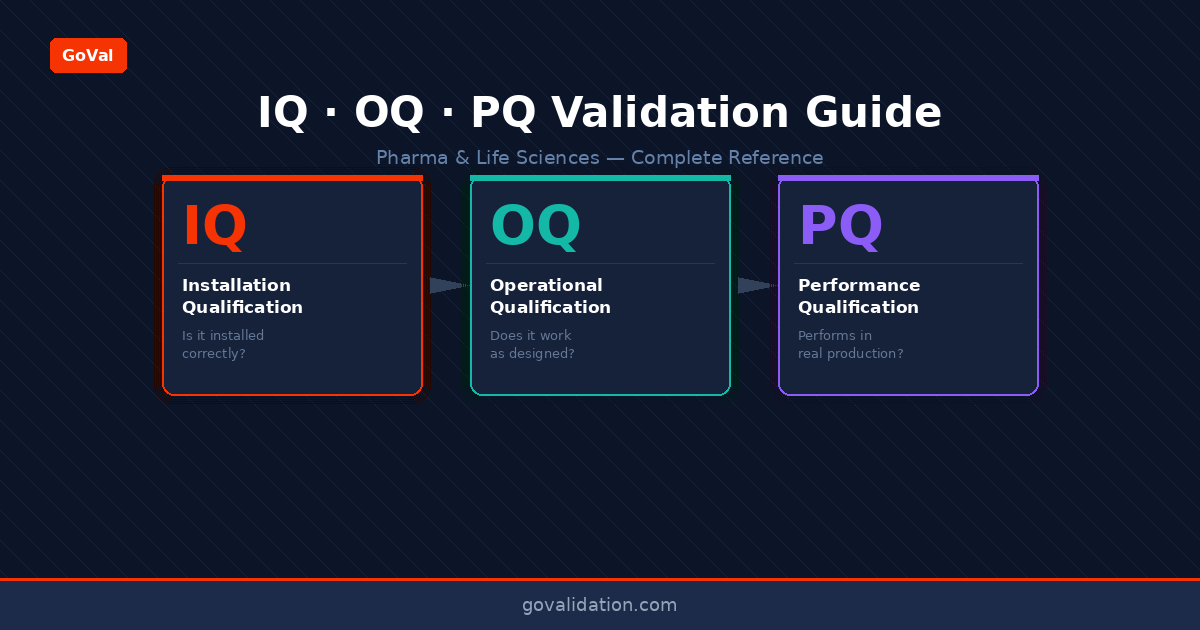
IQ (Installation Qualification) proves the system is installed correctly. OQ (Operational Qualification) proves it works as designed across all functions. PQ (Performance Qualification) proves it performs reliably when real users run real processes. In 2025, retroactive documentation, missing RTM traceability, and absent Part 11 test cases in OQ were the three most cited qualification gaps in FDA 483 observations.
The Three Phases at a Glance
Is it installed exactly per specification — right version, right config, right hardware, all security controls active?
Software version · config baseline · calibration status · audit trail activation · user role setup
Run by: IT / VendorDoes it work as designed across all functions — including boundary conditions, negative tests, and Part 11 controls?
Functional tests · boundary tests · negative tests · audit trail completeness · e-signature integrity
Run by: Validation / QADoes it perform reliably when real users run real business processes under actual production conditions?
Real-world scenarios · representative data volumes · pre-defined measurable acceptance criteria · formal deviation logging
Run by: End Users / QADocuments Required at Each Phase
All documents must be version-controlled and signed per 21 CFR Part 11. Protocols approved before execution begins — never after.
| Document | IQ | OQ | PQ |
|---|---|---|---|
| Validation Plan | ✓ | ✓ | ✓ |
| Qualification Protocol Pre-approved | ✓ | ✓ | ✓ |
| Test Execution Records (signed) | ✓ | ✓ | ✓ |
| Deviation Log | ✓ | ✓ | ✓ |
| Qualification Report | ✓ | ✓ | ✓ |
| Requirements Traceability Matrix Most cited gap | — | ✓ | ✓ |
| Validation Summary Report | — | — | ✓ |
The Six Audit Findings That Keep Appearing
Not rare edge cases — these appear in FDA 483 observations regularly and are all avoidable.
| Finding | What goes wrong |
|---|---|
| Missing RTM High | Test cases cannot be linked to specific URS requirements. RTM assembled after testing rather than maintained throughout execution. |
| Undocumented deviations High | Test failed, someone fixed it informally and re-ran. No deviation record, no root cause, no formal investigation. |
| Retroactive documentation Critical | Protocols written or signed after testing occurred. Timestamps don't match reported test dates. Calls the entire qualification into question. |
| Vague acceptance criteria High | "System should work correctly" is not an acceptance criterion. Every test case needs a specific, measurable expected result defined before execution. |
| No re-qualification High | A vendor pushed an update or config was changed without formal impact assessment. Original qualification is now void. |
| No Part 11 OQ tests High | No specific OQ tests confirming 21 CFR Part 11 audit trail completeness or e-signature integrity. Cited in the vast majority of Part 11-related OQ findings. |
How GoVal Eliminates These Gaps Structurally
| Common gap | How GoVal prevents it |
|---|---|
| Missing RTM | Every test case linked to source requirement at creation — live RTM from day one, never assembled retroactively |
| Retroactive documentation | System-generated tamper-evident timestamps — cannot be backdated by any user including admins |
| Undocumented deviations | Deviation logging built into test execution — cannot complete a test without formally recording the result |
| Vague acceptance criteria | Protocol templates require specific expected results per test case before protocol can be approved |
| Post-change compliance gaps | Change control integrated with validation record — triggers impact assessment automatically on every change |
| Missing Part 11 OQ tests | Pre-built templates include 21 CFR Part 11 audit trail and e-signature test cases as standard in every OQ |
Frequently Asked Questions
What is the difference between IQ, OQ, and PQ? +
Is IQ OQ PQ required for all pharma computer systems? +
What documents are required for IQ, OQ, and PQ? +
How long does IQ OQ PQ validation take? +
When is re-qualification required after a change? +
What are the most common IQ OQ PQ audit findings? +
Does FDA CSA eliminate the need for IQ and OQ? +
What is a Requirements Traceability Matrix and why is it required? +
Complete Your Next Validation in Weeks, Not Months
GoVal gives your team pre-built IQ, OQ, and PQ templates with Part 11 test cases built in, digital execution, automatic live RTM generation, and one-click reports.