
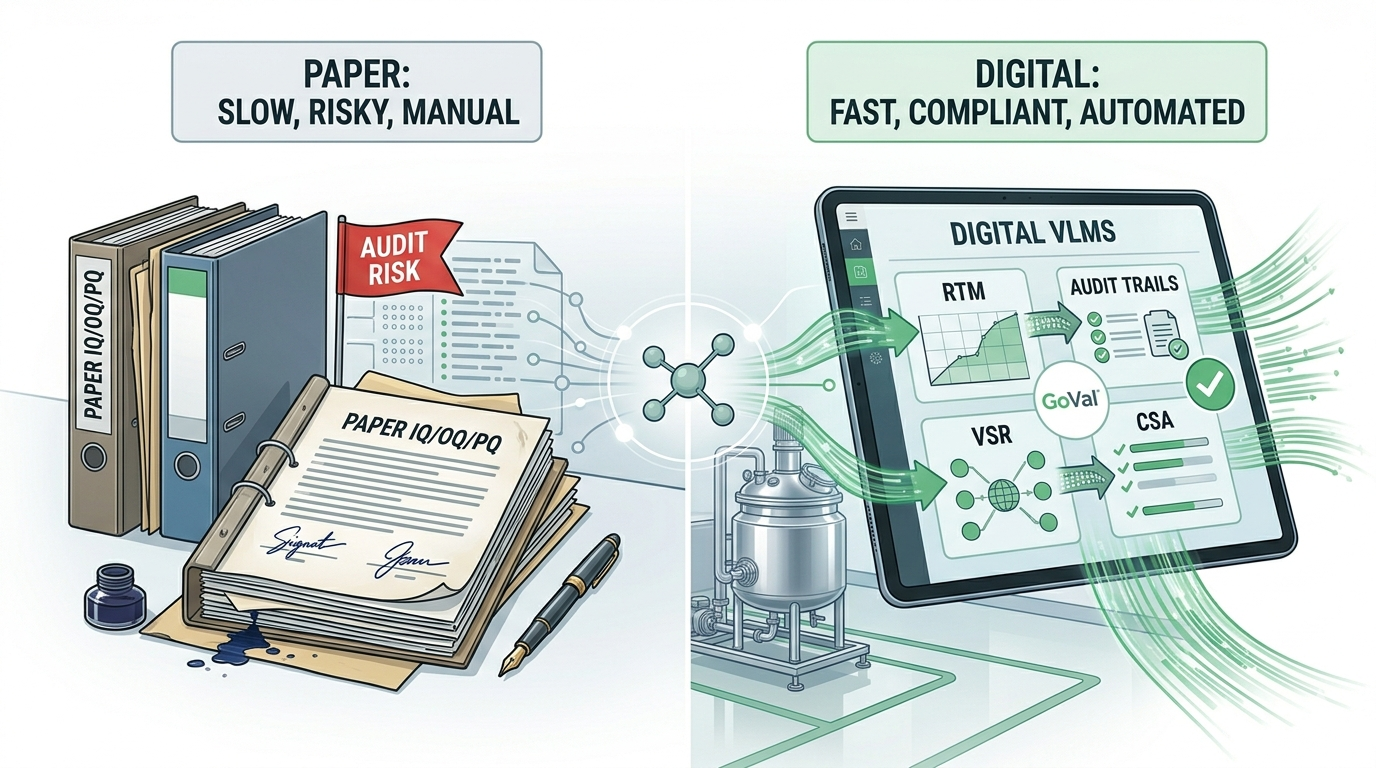
Paper-based validation consumes more than 20% of project budgets, generates the data integrity gaps inspectors flag most, and fails both 21 CFR Part 11 and EU Annex 11 requirements without extensive workarounds. Paperless validation eliminates these risks — but only when implemented in a purpose-built, pre-validated system. Here's what to expect and how to get started.
What Paperless Validation Actually Means
Paperless validation is not scanning paper protocols and storing them in SharePoint. It is the structured replacement of every paper-based validation artefact — URS, IQ/OQ/PQ protocols, test cases, RTM, deviation reports, and VSR — with electronic records managed in a validated, audit-trail-enforced system. The regulatory baseline is 21 CFR Part 11 in the US and EU Annex 11 in Europe. Both require the same core controls: tamper-evident audit trails, uniquely attributed electronic signatures, and access controls — enforced by the system, not by convention.
The Business Case: What the Data Shows
Key Benefits of Paperless Validation
The Real Challenges (and How to Manage Them)
- The platform itself must be validated. Before you use any electronic system in a GxP context, that system requires its own IQ/OQ/PQ. GoVal ships with vendor IQ/OQ documentation included — you don't spend the first months validating the tool you just bought.
- Change management is underestimated. Teams with ten-plus years of paper workflows need structured transition support, not just software access. Plan for it explicitly, not as an afterthought.
- Not all platforms meet both Part 11 and Annex 11. Some tools approximate compliance. Global operations require a system that fully satisfies both frameworks — which means checking audit trail depth, e-signature binding, and access control granularity, not just the marketing claim.
- Data migration from existing records. Transitioning historical paper records requires a defined migration strategy. Starting with new projects in the digital system while archiving historical paper records separately is the most practical approach for most teams.
How to Get Started: Five Practical Steps
- 1Classify your current validation inventory. Identify which systems are active, which are paper-based, and which are highest priority for digitisation — starting with systems under active regulatory scrutiny gives fastest ROI.
- 2Define your compliance baseline. Confirm whether you need 21 CFR Part 11, EU Annex 11, or both — then evaluate platforms against those specific technical requirements, not just feature lists.
- 3Select a pre-validated platform. Avoid the overhead of validating your validation tool. A purpose-built VLMS like GoVal arrives with IQ/OQ/PQ documentation — your team goes live in a compliant system from week one.
- 4Run a pilot project end-to-end. Pick one active validation project and execute it fully in the new system — URS through VSR. Use it to train the team and validate your SOPs before rolling out site-wide.
- 5Update your Validation Master Plan. Reflect the digital workflow, platform controls, and CSA-aligned risk rationale in your VMP. This ensures inspectors see a coherent, documented approach — not a legacy plan describing a paper process you no longer run.
Frequently Asked Questions
What is the best paperless validation software for pharma? +
What is paperless validation in pharma? +
What are the regulatory requirements for paperless validation? +
What are the main benefits of paperless validation? +
What are the challenges of implementing paperless validation? +
How long does it take to implement paperless validation software? +
Ready to take validation paperless?
GoVal goes live in 3–6 weeks with IQ/OQ documentation included — no separate CSV project, no multi-month implementation. See it in a 30-minute walkthrough.
Book a Free Demo →