
What is a Validation Lifecycle Management System (VLMS)?
A Validation Lifecycle Management System (VLMS) connects the evidence needed to plan, execute, approve, maintain, and retire regulated validation activities. Unlike a document repository, a VLMS should preserve relationships between intended use, requirements, risk decisions, test or assurance evidence, deviations, approvals, changes, periodic review, and the current validated state. The value is not simply “paperless validation”; it is a controlled lifecycle where a change in one record can be assessed against the evidence it affects.
If you are comparing platforms, use the 2026 validation software buyer guide, the CSV solution, and the CSA FAQ alongside this VLMS overview.
Lifecycle principle: Validation should be maintained as an evidence-backed state through changes, incidents, supplier updates, review, and retirement — not treated as a project that ends at go-live.
VLMS vs Document Management: The Critical Distinction
A document management system stores files. A VLMS stores structured, interconnected records you can query in real time.
| Question | Document Management System | Validation Lifecycle Management System |
|---|---|---|
| Which systems have overdue periodic reviews? | ✗ No | ✓ Yes |
| Which requirements lack test case coverage? | ✗ No | ✓ Yes |
| What is the deviation rate for this system over 12 months? | ✗ No | ✓ Yes |
| Which systems are affected by this infrastructure change? | ✗ No | ✓ Yes |
| Is my portfolio currently in a validated state? | ✗ No | ✓ Yes |
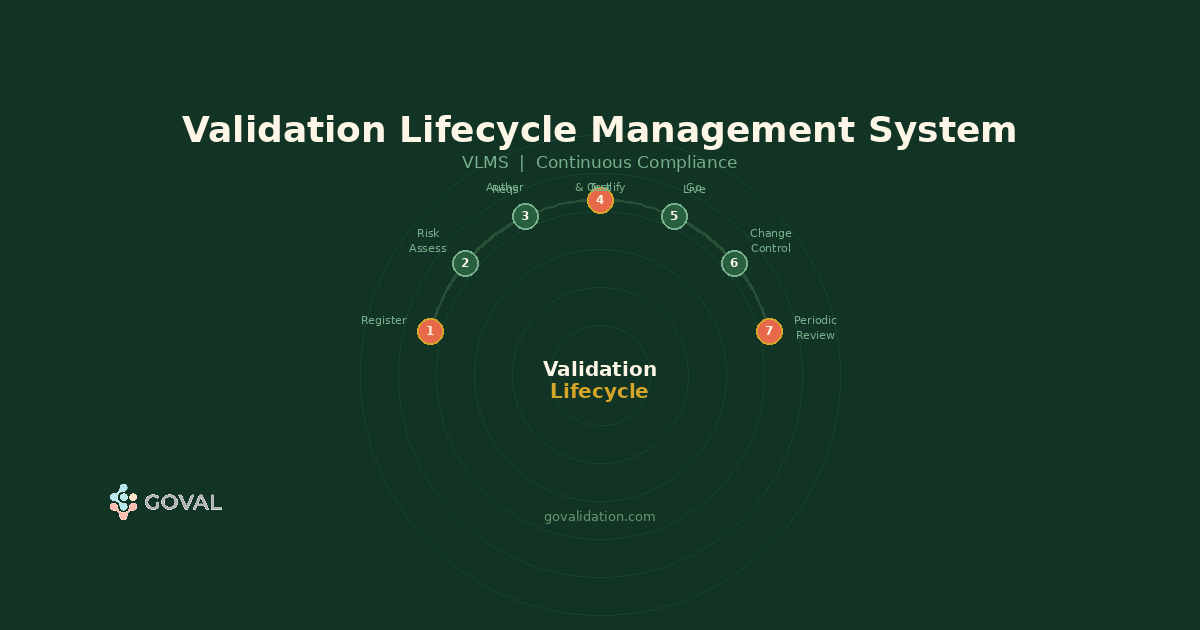
The Seven Lifecycle Stages a VLMS Must Cover
A VLMS that covers only some of these stages forces manual handoffs at every gap — where unvalidated states develop silently.
- System Registration & Scoping: Register every GxP system with its business function, data criticality, GAMP category, and regulatory scope. You cannot manage what you have not catalogued.
- Risk Assessment: Capture intended use, GxP impact, functional risk, complexity, supplier evidence, and software characteristics in the lifecycle record. A VLMS can use that information to guide workflow and evidence planning without treating GAMP category as an automatic risk score.
- Requirements & Specifications: URS, Functional Specs, and Design Specs authored and approved inside the VLMS — linked directly to risk assessment. Each requirement is traceable to its risk and its test cases from the moment it is written.
- Testing & Qualification: IQ, OQ, and PQ protocols authored, executed digitally, and signed within the VLMS. Tamper-evident timestamps at execution. Deviations logged and resolved in the same system. RTM is live throughout — not assembled afterwards.
- Release & Go-Live: Validation Summary Report generated from the VLMS — summarising all qualification evidence, open and closed deviations, and the formal conclusion that the system is fit for intended use.
- Change Management: Connect changes to the affected system, requirements, risks, and evidence so impact assessment can determine whether additional assurance is needed. Workflow routing can support review and approval while preserving the rationale even when no additional testing is required.
- Periodic Review: VLMS schedules, routes, and documents periodic reviews for every validated system. Review evidence — change history, deviation trends, access records — linked within the VLMS. Each review produces a documented decision on validated state.
The Real Cost of Managing Validation Without a VLMS
What the workaround ecosystem looks like — and where it fails under inspection pressure.
What GoVal Delivers as a VLMS
GoVal covers all seven lifecycle stages in one connected platform — no manual handoffs, no silent gaps.
| What You Need | How GoVal Delivers It |
|---|---|
| Real-time portfolio visibility | Dashboard showing validation status, overdue reviews, and open deviations for every system — based on connected source records rather than separate manual status trackers |
| Automatic traceability (RTM) | Live RTM linking every requirement to risk assessment, test cases, and results — updated in real time throughout the lifecycle |
| Integrated change management | Changes logged against validated systems trigger automatic impact assessments and route re-qualification workflows where needed |
| AI-assisted authoring | AI assistance for URS drafting, risk assessment completion, and test case generation |
| Audit-ready at all times | Complete validation records and linked evidence available immediately — not assembled over days in response to an inspection notice |
| CSA and CSV in one platform | Risk-adaptive documentation scaling to each system's GAMP category — proportionate CSA evidence or full CSV documentation |
| Multi-framework support | 21 CFR Part 11, EU Annex 11, GAMP 5, and FDA CSA — all supported simultaneously for dual-regulated organisations |
Related Topics
Frequently Asked Questions
What is a Validation Lifecycle Management System (VLMS)? +
What is the best VLMS software for pharma in 2026? +
How is a VLMS different from a document management system? +
How much does a VLMS cost for a mid-size pharma company? +
Which regulatory standards does a VLMS need to support? +
What is the ROI of implementing a VLMS? +
How many systems can a VLMS manage? +
What is the difference between a VLMS and CSV software? +
See Your Validated Estate in One View
GoVal gives you a real-time picture of your entire GxP portfolio — validation status, periodic review schedule, change history, open deviations, and linked qualification evidence — connected and available for review without rebuilding the record from separate files.